
Compass FAQs
A few of the most frequently asked questions about compasses... and the straight-forward answers!
Click on the question, to see your answer!
How does a compass work? And why does a compass point North?
First, you need to understand that the Earth acts like a giant magnet because of electric currents flowing within its outer core. The Earth’s outer core is liquid and electrically conductive. Heat and chemical processes drive convection in the liquid outer core, while the Earth's rotation helps organize that moving, electrically conductive fluid. Because moving electrically conductive material creates electric currents, and electric currents produce magnetic fields, these enormous currents generate the Earth’s magnetic field. A compass needle is simply a very sensitive, magnetized needle mounted on a pivot so that it can rotate freely. The north-seeking end of the compass needle aligns itself with the Earth’s magnetic field and points generally toward the region of the Earth’s Magnetic North pole.
Does a compass point to True North or Magnetic North?
Traditional mechanical compasses with a needle point towards Magnetic North, not True North. More precisely, the needle aligns itself with the horizontal component of Earth's magnetic field at your location. Because Earth's magnetic field isn't perfectly aligned with the Earth's geographic (True) North/South axis, Magnetic North and True North are different. The difference also varies from one location to another and changes gradually over time. That's why a compass almost never points exactly toward True North.
What is compass declination?
When you are looking at a map that is based on True North, what you really need to know is the difference between where your compass is pointing and the True North pole, as measured in degrees. This difference is called magnetic declination. It is different everywhere on earth, so you really need to know where you are (typically to the nearest 20 miles or so). For reference, most places in the United States are anywhere from 0 to +/- 15 degrees. And yes, your magnetic declination changes over time. But it can take a decade or more, for your declination to move enough to require an adjustment to your compass. You can learn more about magnetic declination here: https://thecompassstore.com/pages/what-is-declination and how to find your declination here: https://thecompassstore.com/pages/how-to-find-your-declination-value.
And you can check out all our compasses with adjustable declination in the collection link at the bottom of this page.
Do compasses work at the North Pole?
Something between “not very well” and “not at all”. Remember the True North Pole is not exactly the same as the Magnetic North Pole – but they are close, globally speaking. And as you approach the Earth’s Magnetic North pole, the Earth’s magnetic field becomes increasingly vertical, so a compass needle has less horizontal force to align with. Very close to the magnetic pole, the needle may become unstable and can point in almost any direction, making a traditional magnetic compass unreliable for determining direction. For this reason, navigation near the poles typically relies on GPS, gyroscopes, or other instruments in addition to a compass.
How accurate is the compass on my phone?
The compass on your phone will show your direction to the nearest 1 degree. But that is the resolution – not the accuracy. In real-world conditions, the accuracy of the digital compass in your phone is roughly 3-8 degrees. This means a Treknor T580 baseplate compass (which can be accurate within 1-2 degrees) is more accurate than your phone.
Does my iPhone use True North or Magnetic North?
Magnetic North is the factory default in the Apple Compass App. But there is a simple toggle switch in the Compass App that can allow you to show your compass directions relative to True North. Simply go to Settings > Apps > Compass, and toggle the “Use True North” on.
Will my handheld compass work in a car?
Not very well, and results vary greatly – even at different locations in the same car. At its core, the compass is a really sensitive magnet. So, any ferrous metal (like steel) will adversely affect the accuracy of the compass needle. Even though your dash looks plastic, there are lots of structural metal components underneath the dash. And then there’s the structural steel in the A-pillar and roof. And don’t forget about your car’s sheet metal body, or the steel chassis, and that big metal engine, and the metal in the seat frame you sit on. Bottom line, if you want your compass to work accurately, you need to get out and away from your car. Probably 10 feet or more – and the further, the better.
How does my car’s compass work without interference?
Compasses can be adjusted for known levels of interference in fixed locations. Your car’s compass is calibrated for the vehicles magnetic characteristics at the exact location inside the car where it is installed during manufacturing. If you were to move your cars compass sensor to a different location in the car, your compass readings would all be off – if it even worked at all.
Do you sell car compasses?
All the vehicle compasses we sold in the past were discontinued by the manufacturers, due to the decreasing need (compasses already in most cars) combined with the high return rate. Vehicle compasses must have compensators for the cars magnetic field. If they don't, they can be extremely inaccurate. Usually, a digital version can adjust for magnetic interference the easiest. But the compass has to be installed in a location away as far from metal as possible. The windshield is typically the best place for an aftermarket compass. But even then, some small cars don't allow the compass to be far enough away from the interference of the car. Then once in its location in the car, it needs to be calibrated with a procedure that typically involves driving the car around an empty parking lot for adjustments. Then once calibrated the compass can't be moved, without calibrating it again. Due to all of these complications, proper calibration can be difficult. Hence the negative reviews, high return rates, and discontinued products. If you can find one, it would be best to be digital and adjust for magnetic interference (most of the digital ones do). Best of luck in your search. There aren’t many out there anymore.
Do I need a compass with a mirror?
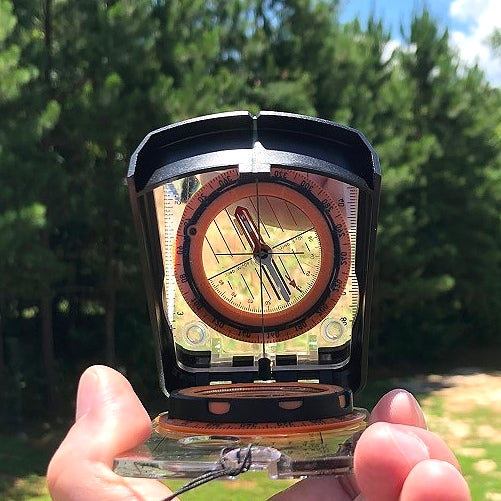
A sighting mirror compass allows you to make direct eye contact with your target while simultaneously viewing the compass needle and bearing. By folding the mirror back at roughly a 45-degree angle and holding the compass up at eye level, you can set your needle while viewing your target. If you have 2 otherwise identical compasses -- one with a mirror, and one without -- in real-world applications you will be more accurate with the mirror compass. And the mirror compass still does everything a baseplate compass can do. We always say, if you can only have one compass, we recommend a mirror sighting compass – it is just the most versatile option. You can check out our mirror compass collection in the link below.
Will my compass work downtown in the city?
Yes, but you may need to be careful about where you use it. Buildings, vehicles, steel structures, power equipment, metal fences, and other objects found in urban areas can interfere with a magnetic compass and cause the needle to point incorrectly. QUICK TIP: If you're downtown and your compass reading seems wrong, move several feet away from cars, buildings, railings, or other metal objects and check it again. If the reading changes significantly, magnetic interference is likely the cause.
Popular Compass Collections
-

Compasses with Adjustable Declination
Each of these compasses with adjustable declination allows you to dial in...
-
Mirror Sighting Compasses
Built with accuracy in mind, a sighting mirror compass allows you to...
-

Baseplate Compasses
Baseplate compasses are great all-around hiking and travel compasses. They typically have a...
-
Pocket & Gift Compasses
A compass gift is the perfect symbol of guidance for the ones...

